HyRES: Residual-Enhanced
Hybrid Image Compression
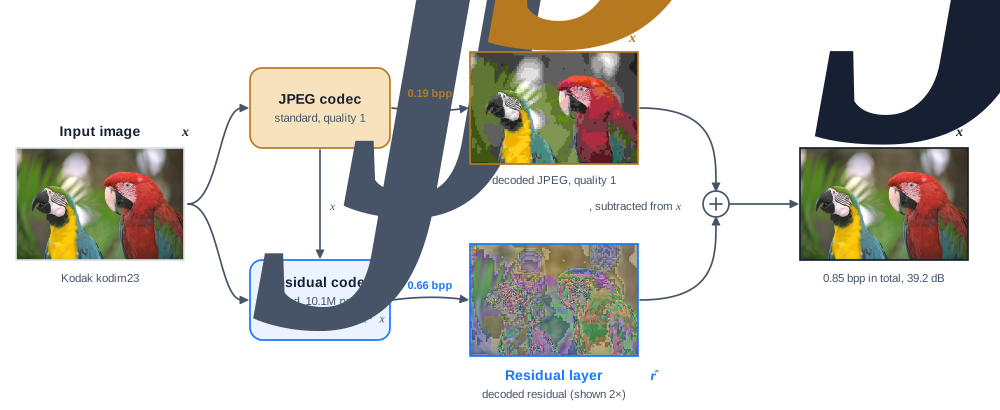
- JPEG first, neural second. We encode with JPEG at quality 1, then a small learned codec encodes only the residual (original minus decoded JPEG).
- Backward compatible. The JPEG part is a standard file, so any viewer can open it without the neural decoder.
- Small and quick. The codec has 10.14M parameters and handles a Kodak image in about 0.76 s on one GPU.
- Measured from real files. All HyRES numbers come from real bitstreams, and measuring them exposed three bugs that we fixed.
Compress what JPEG gets wrong
JPEG is fast and universal but loses detail at low bitrates, while learned codecs compress far better but are large and slow. We keep JPEG as the base layer and use the learned codec only for what JPEG gets wrong.
What the residual looks like
At quality 1, JPEG keeps only coarse 8×8 block averages. The residual holds everything else (edges, texture and color), so that is all the codec has to reproduce.
Residual codec
Training: start sharp, then trade bits away
We train with the rate-distortion loss bpp + λ·MSE, where λ sets the trade-off between file size and error. Early runs at three λ values confirmed that a higher λ gives more bits and lower error. As a result, we split training into six phases: Phase 1 uses a high λ so the model first learns to reconstruct, then λ is lowered step by step, and each phase starts from the previous best checkpoint. We used Mini-ImageNet (60k images) on a single A40.
Rate-distortion on Kodak
All 24 Kodak images at full resolution (768×512), PSNR averaged per image. Published codecs come from CompressAI's benchmark files, and the JPEG curve uses the same TurboJPEG settings as the HyRES base layer.
Speed
Phase 1 at a glance
Per-image results (24 Kodak images)
What re-measuring found
During the project, every number came from the model's training-time estimate. When we later decoded real bitstreams with the surviving weights, we found three bugs. All three are fixed, and none needs retraining.
1. Clamped residual
The decoder clamped the residual to [0, 1], but residuals are signed, so every negative correction was lost.
2. Coding empty positions
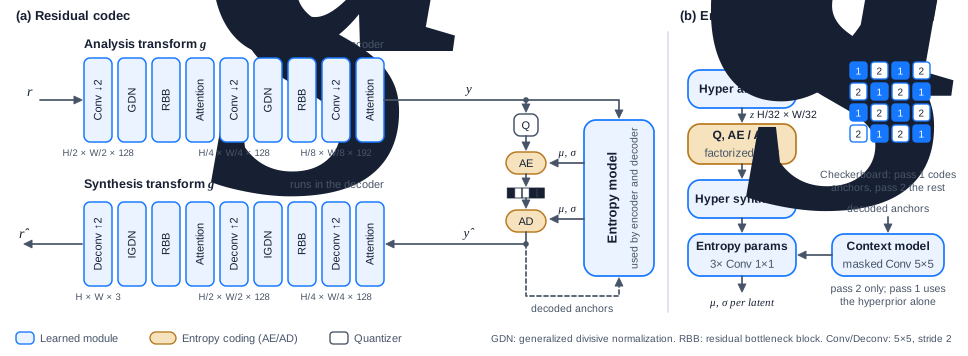
Each checkerboard pass coded the full tensor, including the other pass's empty positions. Now each pass codes only its own positions.
3. Optimistic rate estimate
Training scored each latent with both passes' parameters added together, which no decoder has. It now uses the coder's own parameters.
Bug 3 also means that every model trained so far optimized the wrong rate term. Therefore, retraining with the fixed estimate is the most promising next step.
Limitations
- Only the Phase 1 weights survive, so phases 2 to 6 cannot be re-measured.
- Kodak also selected checkpoints during training, so it is not fully held out.
- Training uses MSE only, so reconstructions are smooth rather than sharp.
- Image sides must be multiples of 32, and inference runs on CUDA or CPU (not Apple MPS).
Next steps
- Retrain all phases with the corrected rate estimate, then report a full rate-distortion curve and a BD-rate against VVC.
- Add perceptual losses (VGG, GAN) for sharper reconstructions.
- Train on a larger dataset and evaluate on a held-out set beyond Kodak.
How it got here
- Feb 2025Proposal. A hybrid codec with a JPEG base and a residual coded only in important regions, chosen by a learned importance map.
- Mar 2025Design. We surveyed learned compression (2018 to 2023) and replaced the importance map with a lightweight residual codec.
- Apr 2025First training runs. Three runs with different λ and JPEG quality confirmed the trade-off and led to the multi-phase schedule.
- May 2025Six phases and refinement. λ from 0.045 down to 0.002, then a refinement network on the frozen final model.
- Oct 2026Re-measurement. Real-bitstream evaluation of the surviving weights, three codec fixes, and this page.
BibTeX
@misc{hyres2025,
  title        = {HyRES: Residual-Enhanced Hybrid Image Compression},
  author       = {Tran, Minh Khang and Dinh, Hoang Dai},
  year         = {2025},
  howpublished = {\url{https://github.com/tmkhang1999/HyRES-Residual-Enhanced-Hybrid-Image-Compression}}
}