Research

My work sits at the intersection of computational colour, image physics, and deep learning. I am especially interested in problems where physical constraints can guide model training.

A coat-rack scene from the Multi-Illumination Dataset, split diagonally: the dark input photograph on the right and the albedo the model recovers from it on the left, brighter and evenly lit
Luminance Constancy in Intrinsic Image Decomposition
via Cross-Illumination Albedo Invariance (CIAI)

A single photograph cannot tell a dark surface from a dimly lit one, so lighting leaks into the recovered albedo. CIAI trains on pairs of real photographs of one scene under different lighting and requires their albedos to agree. As a result, the albedo becomes much more stable in luminance. However, it is not yet stable in colour, because the explanation loss uses brightness only. The next stage splits the shading into a grey part and a colour part.

Minh Khang Tran, Seyed Ali Amirshahi, Luis Gomez Robledo, Sezer Karaoglu, Theo Gevers

Research project  ·  from MSc thesis, COSI / NTNU  ·  2026
Two versions of one portrait from the paper's Figure 1: more texture and more noise on the left, less noise and less texture on the right
 Best Student Paper — IS&T Electronic Imaging 2026
Adapting DeQA-Score for Attribute-Specific Portrait Quality Assessment

Fine-tuned a vision-language quality model to score portrait noise, texture, and contrast separately, for camera portrait-mode benchmarking.

Yujin Cho, Minh Khang Tran, Benoit Pochon, Jean-Michel Morel, Gabriele Facciolo, Sira Ferradans

IS&T Electronic Imaging 2026  Best Student Paper
One image split in two: the quality-1 JPEG base layer on the left, the HyRES output on the right
HyRES: Residual-Enhanced Hybrid Image Compression

Keeps a quality-1 JPEG as the base layer and adds a 10M-parameter neural codec for what the JPEG got wrong, so every file is still a valid JPEG. On Kodak it reaches 37.41 dB at 1.56 bpp, 2.1 dB above JPEG at the same file size.

Minh Khang Tran, Dinh Hoang Dai  ·  Mentor: Damien Muselet

Course Research Project  ·  Jean Monnet University 2025
TextMAE keeps 144 of 196 patches of an image (the dropped ones shown gray), compresses them with a learned MAE codec, and decodes the full image
TextMAE: Text-Guided Masked Autoencoder for Image Compression

Sends only the informative patches of an image plus a one-sentence caption. A Masked Autoencoder and a caption-guided Stable Diffusion refiner rebuild the rest at very low bit rates.

Minh Khang Tran, Thang Nguyen

Mentored Project  ·  FPT Software AI Center 2024

Coursework

Selected technical reports from COSI coursework across the consortium — Université Jean Monnet (France), NTNU (Norway), and the University of Eastern Finland.
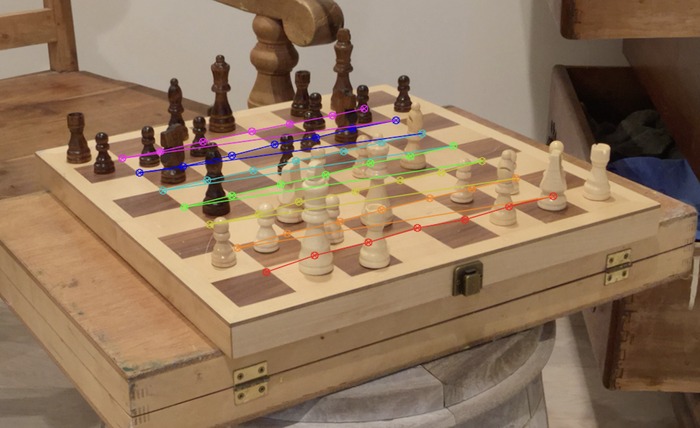
3D Multi-View Stereo Reconstruction report title page
3D Multi-View Stereo Reconstruction: ETH3D and Middlebury Chess

A full classical stereo pipeline (calibration, SGBM disparity, ICP fusion, meshing) on ETH3D and Middlebury Chess. The fused point cloud reached a Chamfer distance of 0.043 m and F1 0.638.
Minh Khang Tran, Anirban Das

3D Computer Vision  ·  Université Jean Monnet 2025
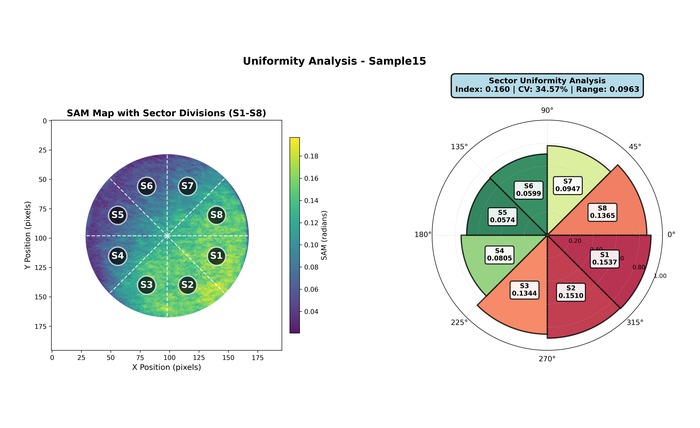
Multi-Spectral Vision System for IC Grating Inspection report title page
Multi-Spectral Vision System for Quality Inspection of In-Coupler Gratings in AR Displays

A 450–950 nm hyperspectral inspection pipeline for AR-waveguide gratings, built with Dispelix Oy. Three metrics separated all 5 defect types, and a 4-operator Gage R&R study kept measurement error under 12%.
Anirban Das, Minh Khang Tran, Kidu Walegerima, Luel Gebre

4C Industrial Project  ·  University of Eastern Finland 2025
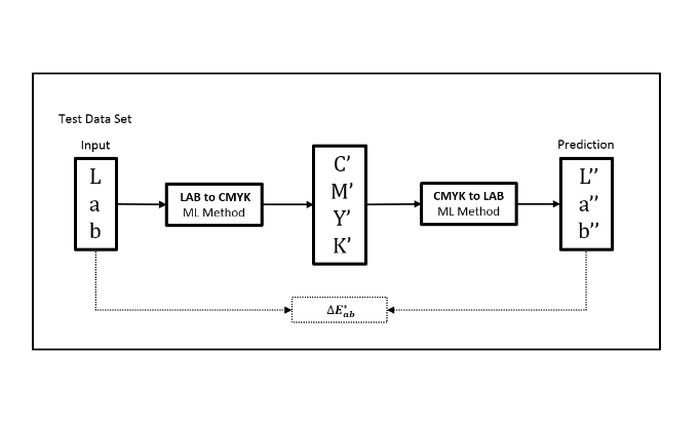
DemoIccMAX vs ML models report title page
Comparative Analysis of Machine Learning Models and DemoIccMAX Tools in CMYK-CIELAB Color Space Transformation

Benchmarked ANN, DNN, SVR, and RBF regressors against ICC-profile colour transforms on FOGRA51. The classical DemoIccMAX transform won on every metric (median round-trip ΔE00 0.5 vs 2.38 for the best ML model).
Minh Khang Tran

Color Management  ·  NTNU 2026
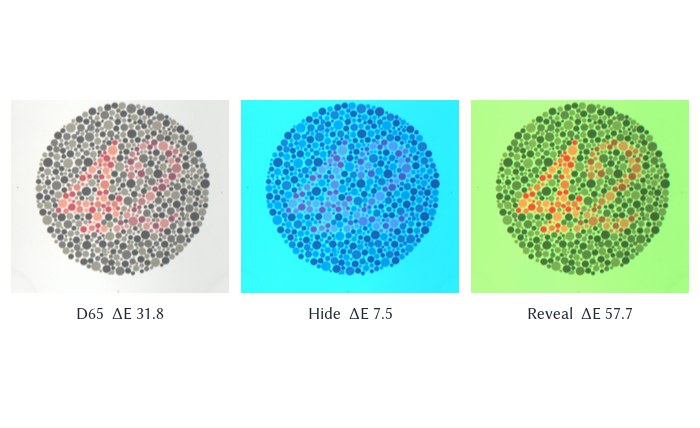
An Ishihara plate showing the numeral 42 rendered under D65, under an LED mix that hides the numeral, and under one that makes it stand out
Spectrally Optimal Light Sources: Designing LED Illumination to Hide or Reveal an Ishihara Numeral

Measured an Ishihara plate with a hyperspectral camera and ten LED channels with a spectrometer, then used particle swarm optimisation to find LED mixes that cut the numeral–background ΔE from 31.8 to 7.5 or raised it to 57.7. All six lights were reproduced on a tunable LED source and matched the predicted spectra at r ≥ 0.997.
Minh Khang Tran

Color Science Laboratory  ·  University of Eastern Finland 2025
Analyzing Gaze Behavior During Emotion Recognition report title page
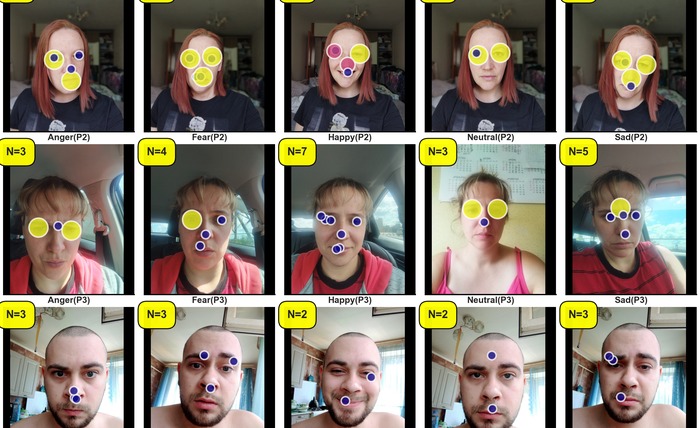
Analyzing Gaze Behavior During Emotion Recognition Using I-DT Fixation Detection

A controlled eye-tracking experiment on emotion-recognition gaze patterns, using dispersion-threshold fixation detection.

Minh Khang Tran, Kidu Welegerima, Kashif Ali Javaid, Muhammad Zeeshan Masood, Luel Gebre, Abdullah Al Ryan, Anirban Das, Farooq Kadri

Eye Tracking  ·  University of Eastern Finland 2025